
Thomas Jefferson hated confrontation, and yet his understanding of power and of human nature enabled him to move men and to marshal ideas, to learn from his mistakes, and to prevail. Passionate about many things—women, his family, books, science, architecture, gardens, friends, Monticello, and Paris—Jefferson loved America most, and he strove over and over again, despite fierce opposition, to realize his vision: the creation, survival, and success of popular government in America. Jon Meacham lets us see Jefferson’s world as Jefferson himself saw it, and to appreciate how Jefferson found the means to endure and win in the face of rife partisan division, economic uncertainty, and external threat. Drawing on archives in the United States, England, and France, as well as unpublished Jefferson presidential papers, Meacham presents Jefferson as the most successful political leader of the early republic, and perhaps in all of American history.
The father of the ideal of individual liberty, of the Louisiana Purchase, of the Lewis and Clark expedition, and of the settling of the West, Jefferson recognized that the genius of humanity—and the genius of the new nation—lay in the possibility of progress, of discovering the undiscovered and seeking the unknown. From the writing of the Declaration of Independence to elegant dinners in Paris and in the President’s House; from political maneuverings in the boardinghouses and legislative halls of Philadelphia and New York to the infant capital on the Potomac; from his complicated life at Monticello, his breathtaking house and plantation in Virginia, to the creation of the University of Virginia, Jefferson was central to the age. Here too is the personal Jefferson, a man of appetite, sensuality, and passion.
The Jefferson story resonates today not least because he led his nation through ferocious partisanship and cultural warfare amid economic change and external threats, and also because he embodies an eternal drama, the struggle of the leadership of a nation to achieve greatness in a difficult and confounding world.
My Thoughts:
This book was absolutely fascinating. I learned so much that I don’t even know where to begin! Thomas Jefferson (or TJ as I like to call him) was fiercely in love with his country. He fought tooth and nail for the things he believed in. He knew how to get things done by using both his political power and his personality.
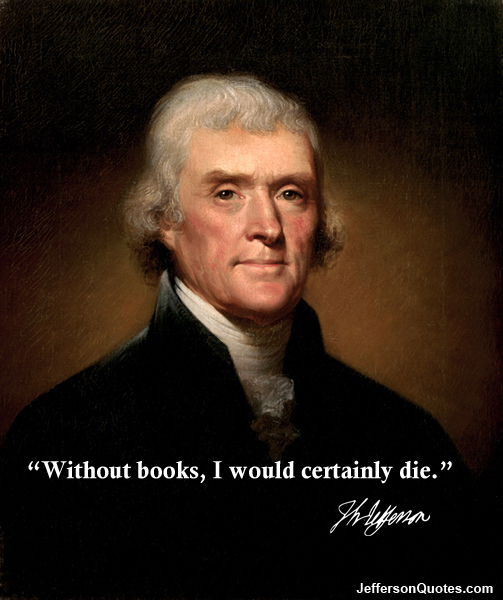
One of the things that struck me was how much TJ loved to learn. He was endlessly interested in other cultures and languages. He knew how important education was and he never wanted to stop learning about almost every subject imaginable. Jefferson was a voracious reader. When his home burned down the first question he asked was about his books. Sadly, they were all ruined. He restarted his collection immediately which eventually became the Library of Congress.
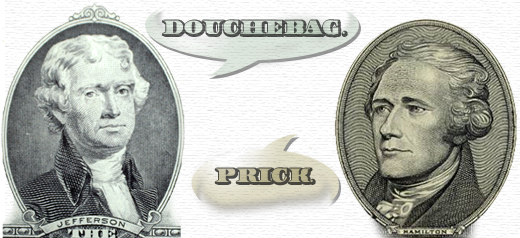
Reading about the feud between Thomas Jefferson and Alexander Hamilton was riveting. They did not like each other…and that is putting it mildly. Hamilton was a little too friendly with the British for Jefferson’s taste. TJ was always concerned about the return of the monarchy to the United States. Some would say he was paranoid but when you consider the times it was definitely something to worry about. You can imagine his anger when he heard that Hamilton had toasted King George. Not cool Hamilton, not cool at all.
After Hamilton’s death, Jefferson displayed a bust of his enemy in his home. Even though they were mightily opposed Jefferson respected him. Doesn’t that say a lot about what kind of man TJ was?
 |
| Source |
You’re probably aware that Jefferson kept slaves. (Talk about not cool!) Interestingly, Jefferson tried multiple times to talk about abolition. When he wrote the Declaration of Independence he really did mean that ALL men are created equal. He included language about freeing slaves but the passages were struck out by others.
I knew that TJ was instrumental in the United States Revolution. I knew that he fathered children with one of his slaves. I knew he had written the Declaration of Independence. But there is so much about this man that I didn’t know.
I’m better for having read this book. You will be too.

 The Relentless Reader