

 Meet Luca, a curious young boy living with his mother, a taciturn woman who “every now and then tries out a new father.” Luca keeps to himself, his cat, Blue, and his words–his favorite toys. One February morning his mom doesn’t wake up to bring him to school, so Luca–with a father who’s long gone and driven by a deep fear of being an orphan (“part of you is missing and people only see the part that isn’t there”)–decides to pretend to the world that his mom is still alive. Luca has a worldly comprehension of humanity, and grapples with his gruesome situation as the stench of the rotting body begins to permeate his home.
 But this remarkable narrative is not insufferably morbid. Luca also pretends that Blue is his personal assistant and that they’re on an expedition in outer space together; he goes for observant trips to the store, where he uses the contents of a basket to astutely assess the person who’s filled it; he fantasizes about marrying his school crush, Antonella (whose freckles on her nose are described as being a pinch of cinnamon on whipped cream.)
Ultimately, we are witness to something much more poignant that needs no translation: the journey of a young boy deciding–in a more devastating manner than most–to identify himself independently, reaching the point at which he can say: “I am no longer an orphan. I am a single human being. It’s a matter of words.”
 |
| Valerie Martin |
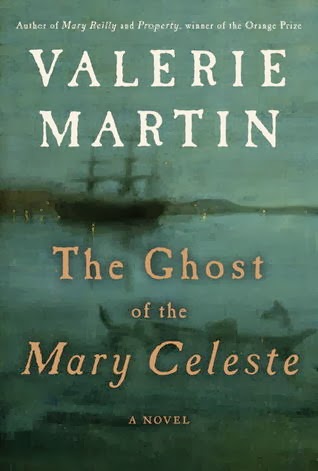
In 1872 the American merchant vessel Mary Celeste was discovered adrift off the coast of Spain. Her cargo was intact and there was no sign of struggle, but the crew was gone. They were never found.
This maritime mystery lies at the center of an intricate narrative branching through the highest levels of late-nineteenth-century literary society. While on a voyage to Africa, a rather hard-up and unproven young writer named Arthur Conan Doyle hears of the Mary Celeste and decides to write an outlandish short story about what took place. This story causes quite a sensation back in the United States, particularly between sought-after Philadelphia spiritualist medium Violet Petra and a rational-minded journalist named Phoebe Grant, who is seeking to expose Petra as a fraud. Then there is the family of the Mary Celeste‘s captain, a family linked to the sea for generations and marked repeatedly by tragedy. Each member of this ensemble cast holds a critical piece to the puzzle of the Mary Celeste.
These three elements—a ship found sailing without a crew, a famous writer on the verge of enormous success, and the rise of an unorthodox and heretical religious fervor—converge in unexpected ways, in diaries, in letters, in safe harbors and rough seas. In a haunted, death-obsessed age, a ghost ship appearing in the mist is by turns a provocative mystery, an inspiration to creativity, and a tragic story of the disappearance of a family and of a bond between husband and wife that, for one moment, transcends the impenetrable barrier of death.
My Quick Thoughts:
If you’ve hung out here on a regular basis you know that I love historical fiction. I especially love historical fiction that is based in truth. This was one such book. There really was a ship called The Mary Celeste and it really did disappear. This was the sort of book that made me want to look things up and learn more about the topics it contained. That makes me a very happy reader.
The problem I had was with the way the story jumped around. It moved back and forth in time and from one set of characters to another in a way that felt disjointed. That’s more of a quibble really. I would recommend this to any fan of historical fiction.
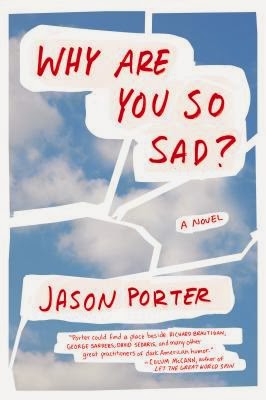
 Have we all sunken into a species-wide bout of clinical depression?
Porter’s uproarious, intelligent debut centers on Raymond Champs, an illustrator of assembly manuals for a home furnishings corporation, who is charged with a huge task: To determine whether or not the world needs saving. It comes to him in the midst of a losing battle with insomnia — everybody he knows, and maybe everybody on the planet, is suffering from severe clinical depression. He’s nearly certain something has gone wrong. A virus perhaps. It’s in the water, or it’s in the mosquitoes, or maybe in the ranch flavored snack foods. And what if we are all too sad and dispirited to do anything about it? Obsessed as he becomes, Raymond composes an anonymous survey to submit to his unsuspecting coworkers — “Are you who you want to be?”, “Do you believe in life after death?”, “Is today better than yesterday?” — because what Raymond needs is data. He needs to know if it can be proven. It’s a big responsibility. People might not believe him. People, like his wife and his boss, might think he is losing his mind. But only because they are also losing their minds. Or are they?
Reminiscent of Gary Shteyngart, George Saunders, Douglas Coupland and Jennifer Egan, Porter’s debut is an acutely perceptive and sharply funny meditation on what makes people tick.


 The Relentless Reader