
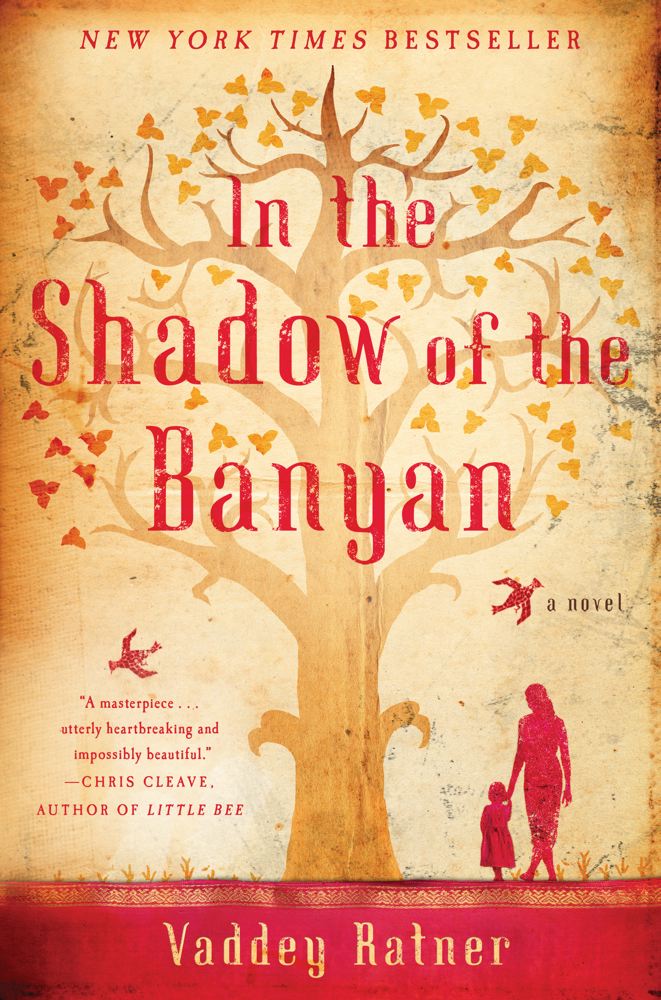
Review: In the Shadow of the Banyan by Vaddey Ratner

You are about to read an extraordinary story. It will take you to the very depths of despair and show you unspeakable horrors. It will reveal a gorgeously rich culture struggling to survive through a furtive bow, a hidden ankle bracelet, fragments of remembered poetry. It will ensure that the world never forgets the atrocities committed by the Khmer Rouge regime in Cambodia between 1975 and 1979, when an estimated two million people lost their lives. It will give you hope, and it will confirm the power of storytelling to lift us up and help us not only survive but transcend suffering, cruelty, and loss.

For seven-year-old Raami, the shattering end of childhood begins with the footsteps of her father returning home in the early dawn hours, bringing details of the civil war that has overwhelmed the streets of Phnom Penh, Cambodia’s capital. Soon the family’s world of carefully guarded royal privilege is swept up in the chaos of revolution and forced exodus. Over the next four years, as the Khmer Rouge attempts to strip the population of every shred of individual identity, Raami clings to the only remaining vestige of her childhood— the mythical legends and poems told to her by her father. In a climate of systematic violence where memory is sickness and justification for execution, Raami fights for her improbable survival. Displaying the author’s extraordinary gift for language, In the Shadow of the Banyan is a brilliantly wrought tale of human resilience.

I hadn’t read much about this time period in Cambodia and I was very much looking forward to learning about it. Maybe I should have read some nonfiction about this subject first.

I wanted to like this book and I was nearly sure that I would. Sadly, I was mistaken. I did enjoy parts, but as a whole it didn’t speak to me. The language felt a bit too flowery and there wasn’t enough solid information about what was going on.

The author’s note at the end was where I finally felt a connection to the book. She talked about her own experiences as a young girl in Cambodia during the Khmer Rouge’s regime. That was when I felt myself choking up, thinking of what she and her family went through.Vaddey Ratner’s personal story is amazing. I can’t imagine how painful it was for her to write this book.

 I so wish she had written a memoir instead of a fictional account. She does talk about why she didn’t, and her reasons make absolute sense. 

Books I Loved Before I Blogged #1

Until I started this blog I had almost no one to talk books with. After I read something amazing I’d walk around feeling like I was going to explode unless I SHARED ALL MY FEELINGS ABOUT THIS BOOK.

Sometimes I couldn’t hold it in, I would start talking about the latest great book to someone, anyone. I had to say the words out loud. I had to beg someone to PLEASE PLEASE OH GOD PLEASE READ THIS IT WILL CHANGE YOUR LIFE I SWEAR!

The reaction I usually received. Hmph.

I’ve only been blogging for a few months. I’ve been reading for decades. Can you even imagine how many books I’ve read and loved? Hundreds. Can you imagine all the feelings I’ve had to stuff down so that I didn’t bore my family members and friends to death? Hundreds more.

No more! 

Now, thanks to my blog I can talk about all the books I want! Mwahahaha! Is anyone reading this? I don’t know! But I do know this: If someone is reading this I won’t have to see their eyes glazing over or their fingertips drumming the nearest table top. If someone is here, they are here to read about BOOKS! 
Blessings upon you blogosphere. 
Thank you for listening!

I’m starting a regular feature to pimp some books that I loved before I was a blogger. Perhaps a semi-regular feature? Maybe a whenever I feel like it sort of feature. Maybe just this one post. We’ll see. Be patient with me people, I’m a newbie.

Books I Loved Before I Blogged #1

Mao’s Great Famine 
The History of China’s Most Devastating Catastrophe
by Frank Dikotter
I’ll never forget this book for as long as I live.

“Between 1958 and 1962, China descended into hell. Mao Zedong threw his country into a frenzy with the Great Leap Forward, an attempt to catch up to and overtake Britain in less than 15 years The experiment ended in the greatest catastrophe the country had ever known, destroying tens of millions of lives.” So opens Frank Dikötter’s riveting, magnificently detailed chronicle of an era in Chinese history much speculated about but never before fully documented because access to Communist Party archives has long been restricted to all but the most trusted historians. A new archive law has opened up thousands of central and provincial documents that “fundamentally change the way one can study the Maoist era.” Dikötter makes clear, as nobody has before, that far from being the program that would lift the country among the world’s superpowers and prove the power of Communism, as Mao imagined, the Great Leap Forward transformed the country in the other direction. It became the site not only of “one of the most deadly mass killings of human history,”–at least 45 million people were worked, starved, or beaten to death–but also of “the greatest demolition of real estate in human history,” as up to one-third of all housing was turned into rubble). The experiment was a catastrophe for the natural world as well, as the land was savaged in the maniacal pursuit of steel and other industrial accomplishments. In a powerful mesghing of exhaustive research in Chinese archives and narrative drive, Dikötter for the first time links up what happened in the corridors of power-the vicious backstabbing and bullying tactics that took place among party leaders-with the everyday experiences of ordinary people, giving voice to the dead and disenfranchised. His magisterial account recasts the history of the People’s Republic of China.